
Good Design & Quality is Timeless






BA73869
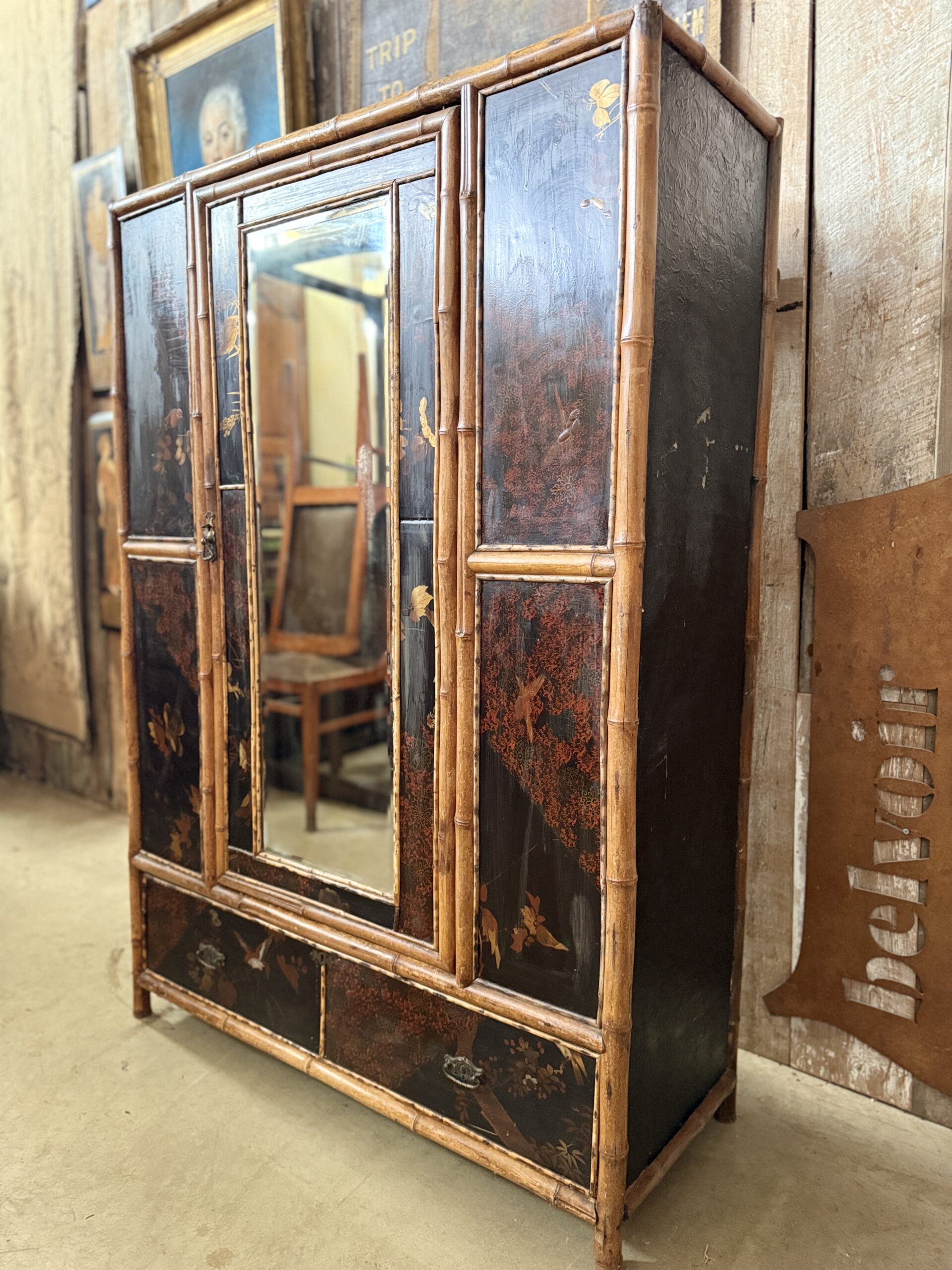
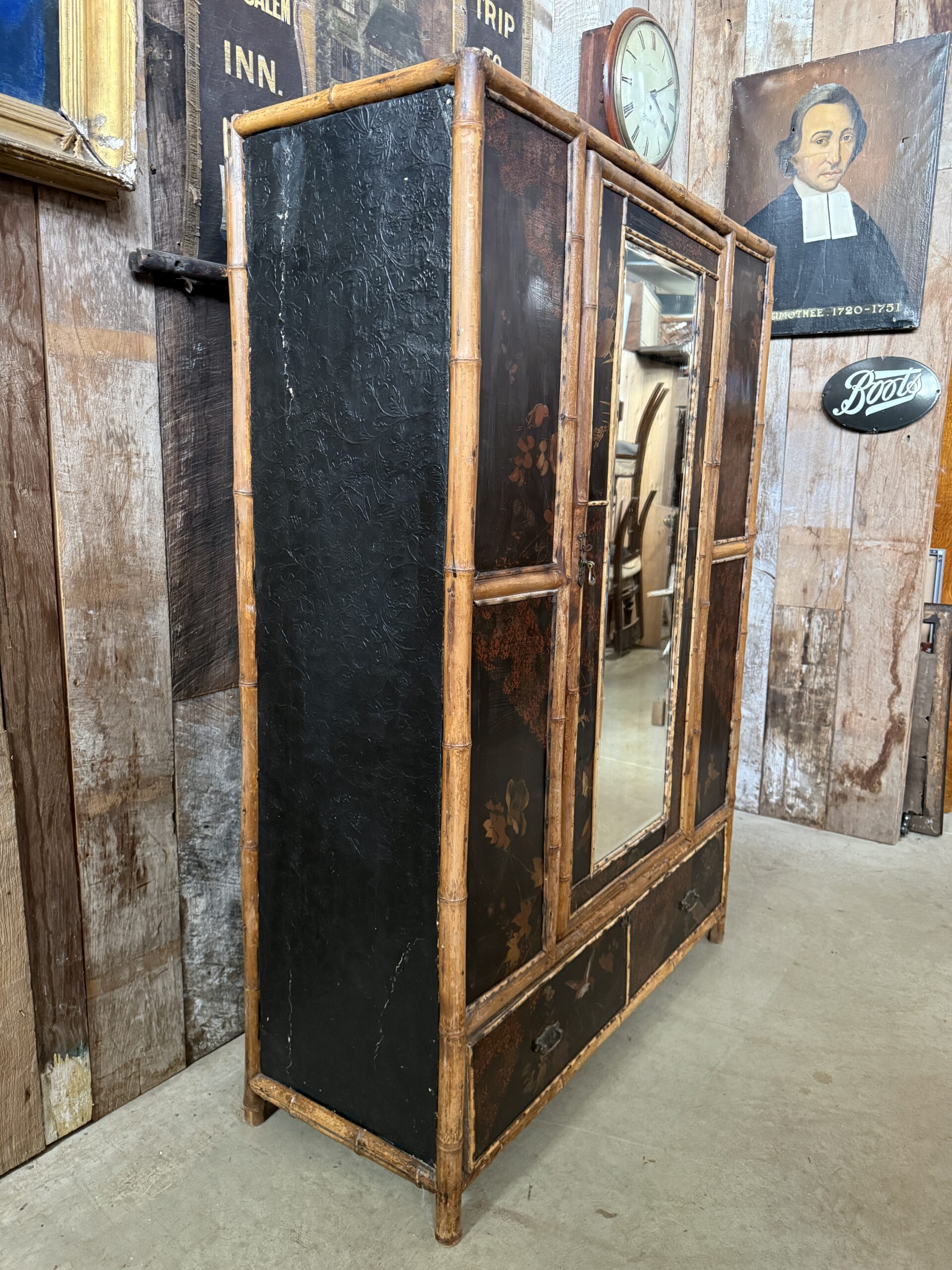
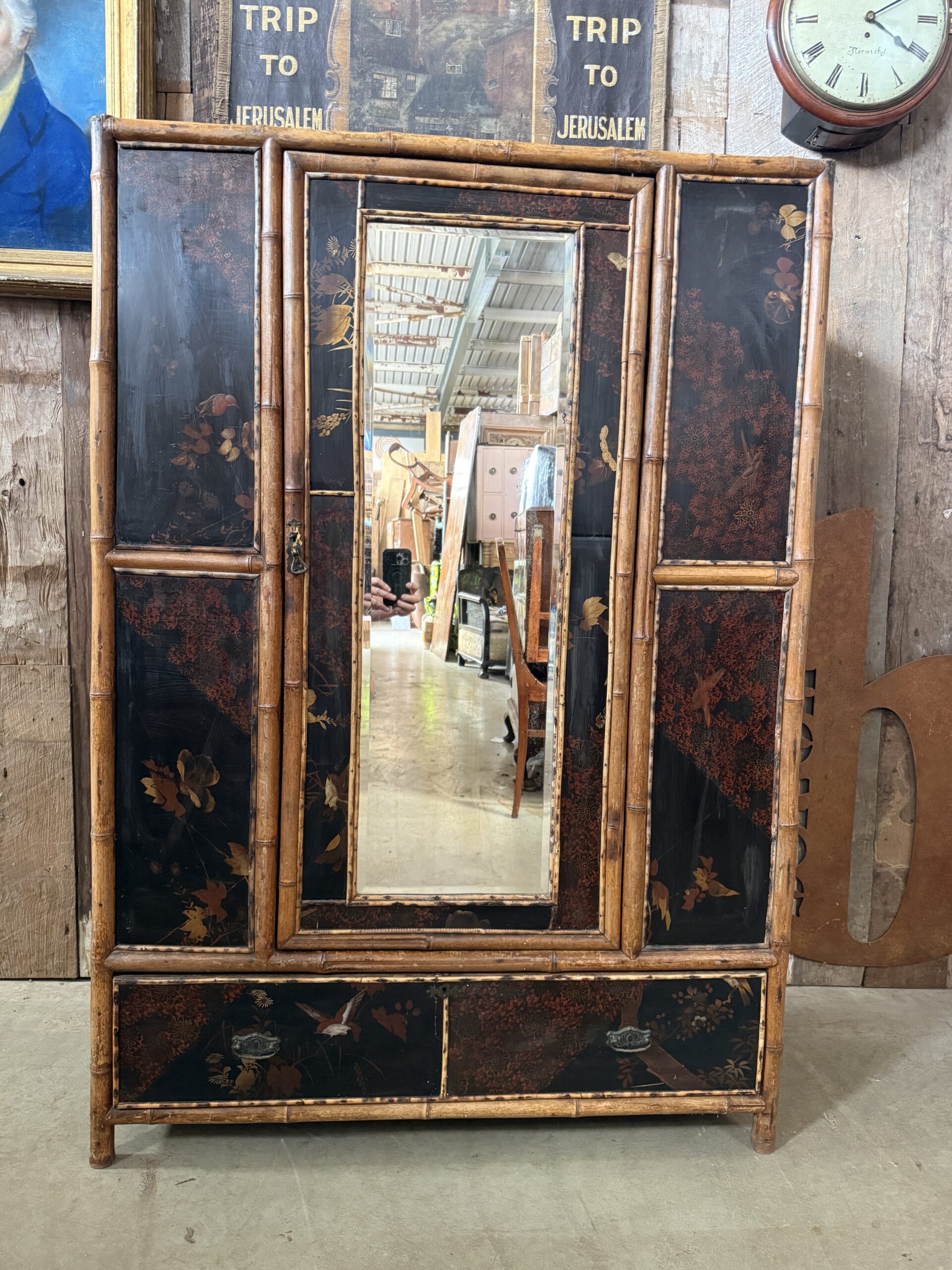
Antique Late Victorian Bamboo Chinoiserie Aesthetic Movement Mirrored Hall Robe, c.1890
2252
An exceptionally decorative and increasingly difficult-to-find Late Victorian bamboo Chinoiserie mirrored hall robe, dating to circa 1890 and representing the Victorian Aesthetic Movement’s fascination with Japanese and East Asian design.
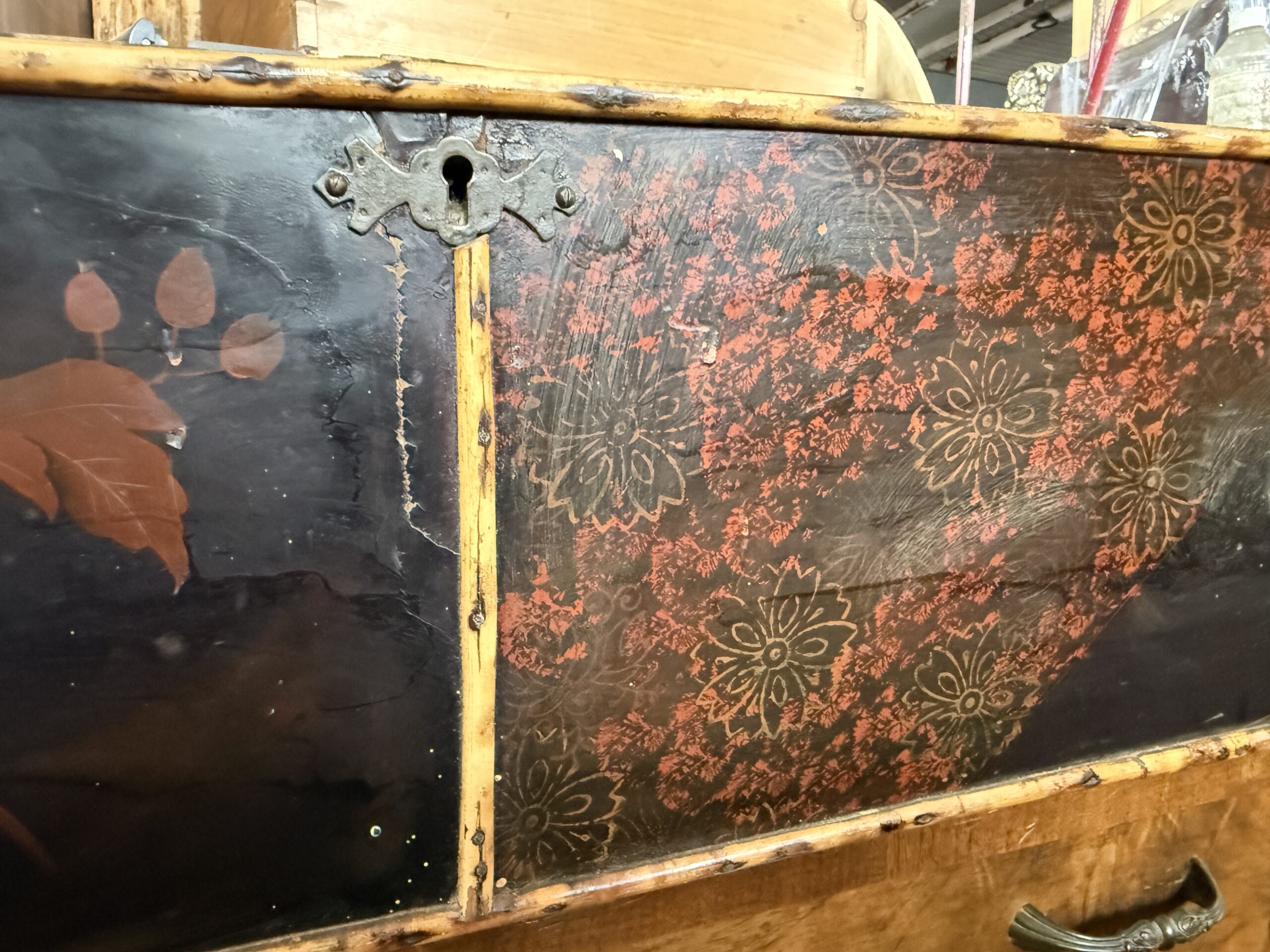
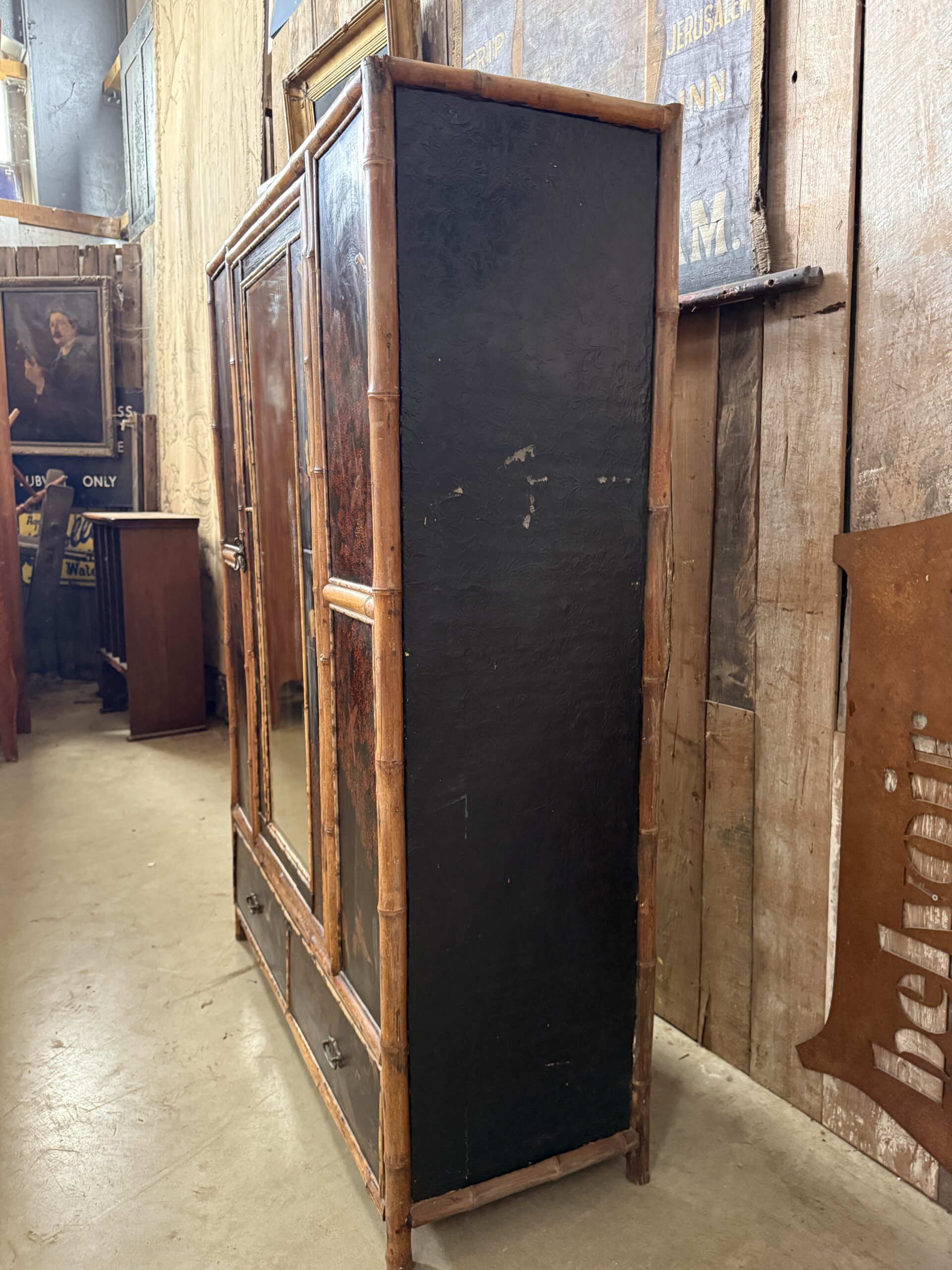
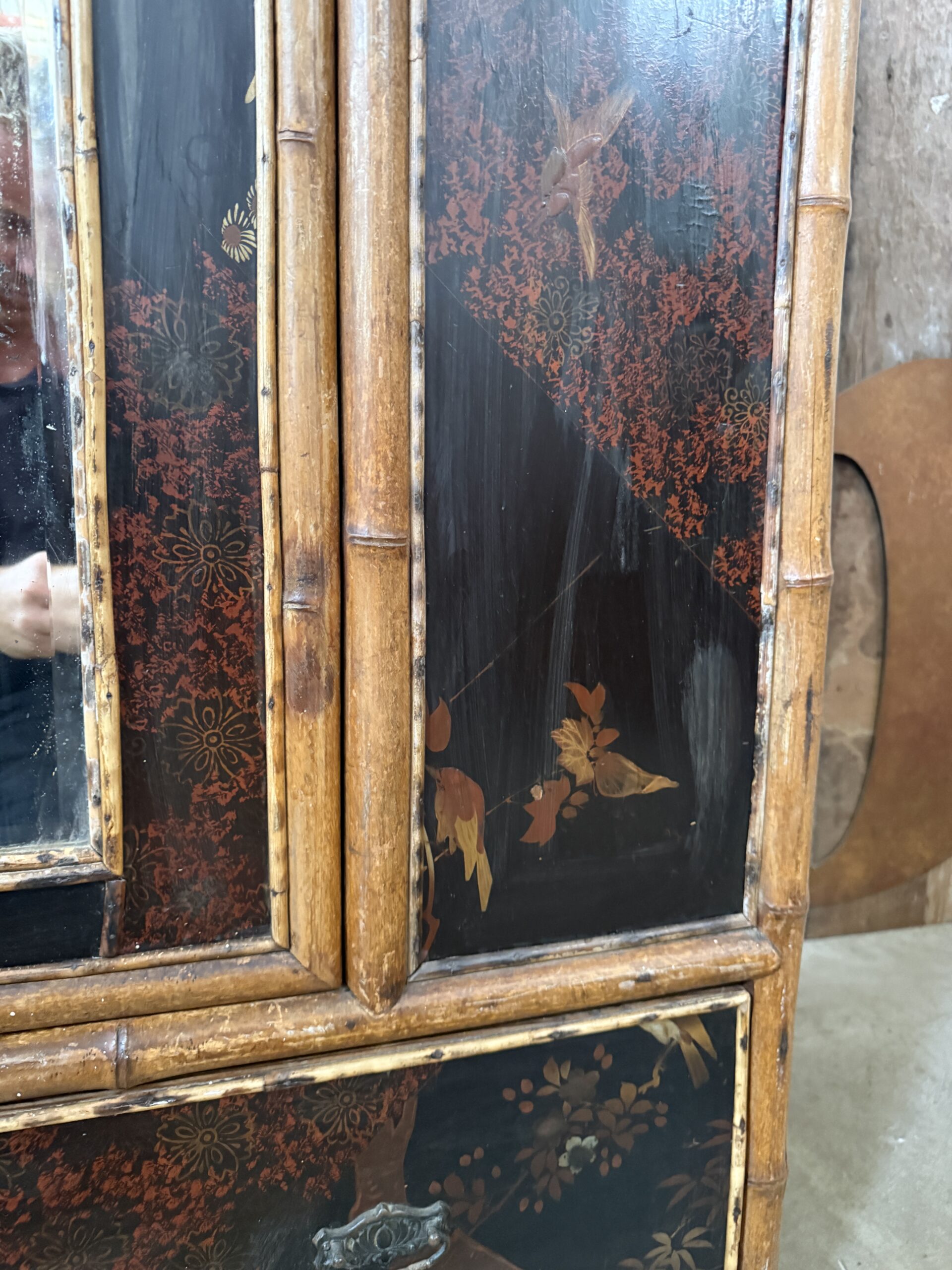
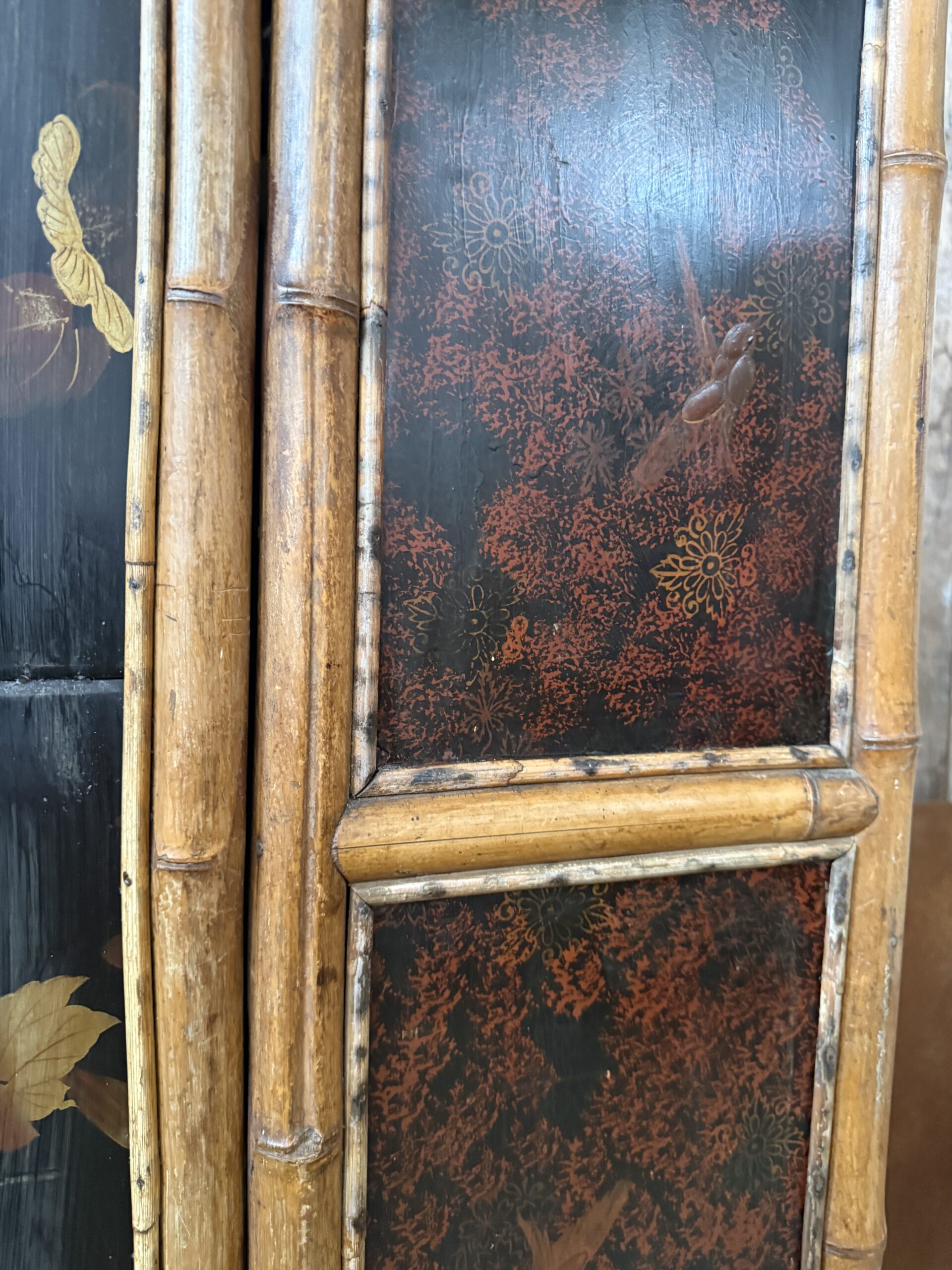
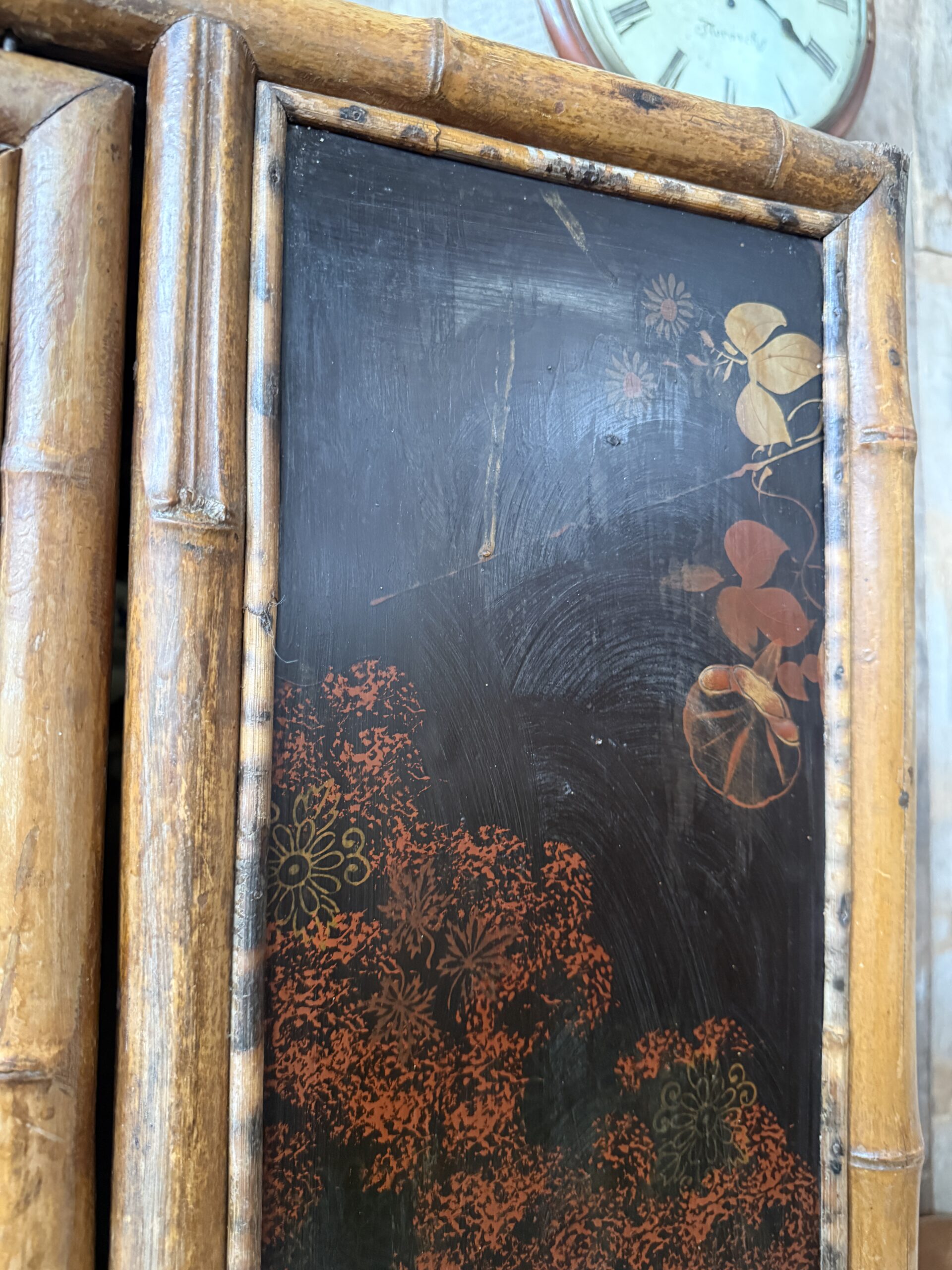
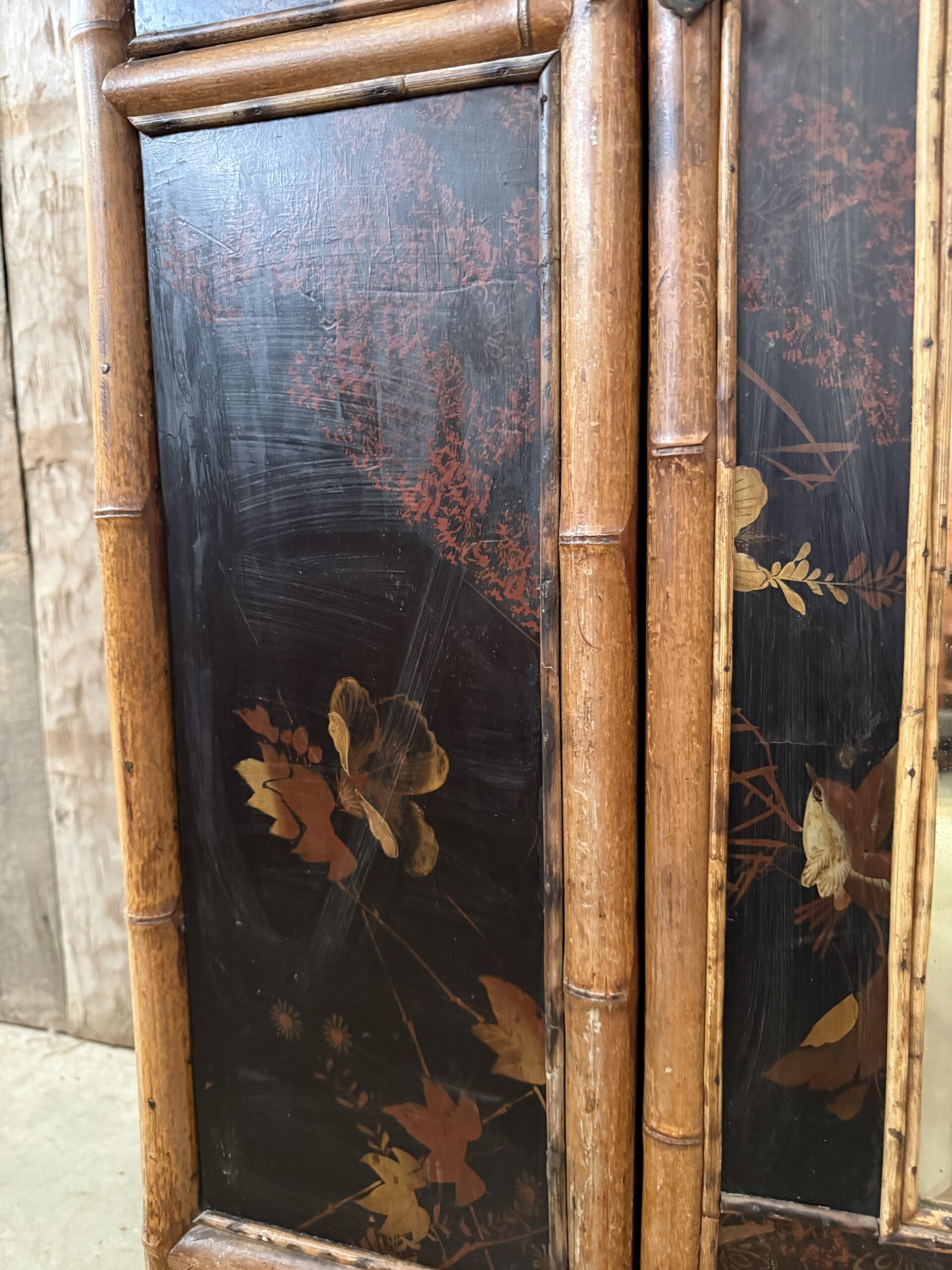
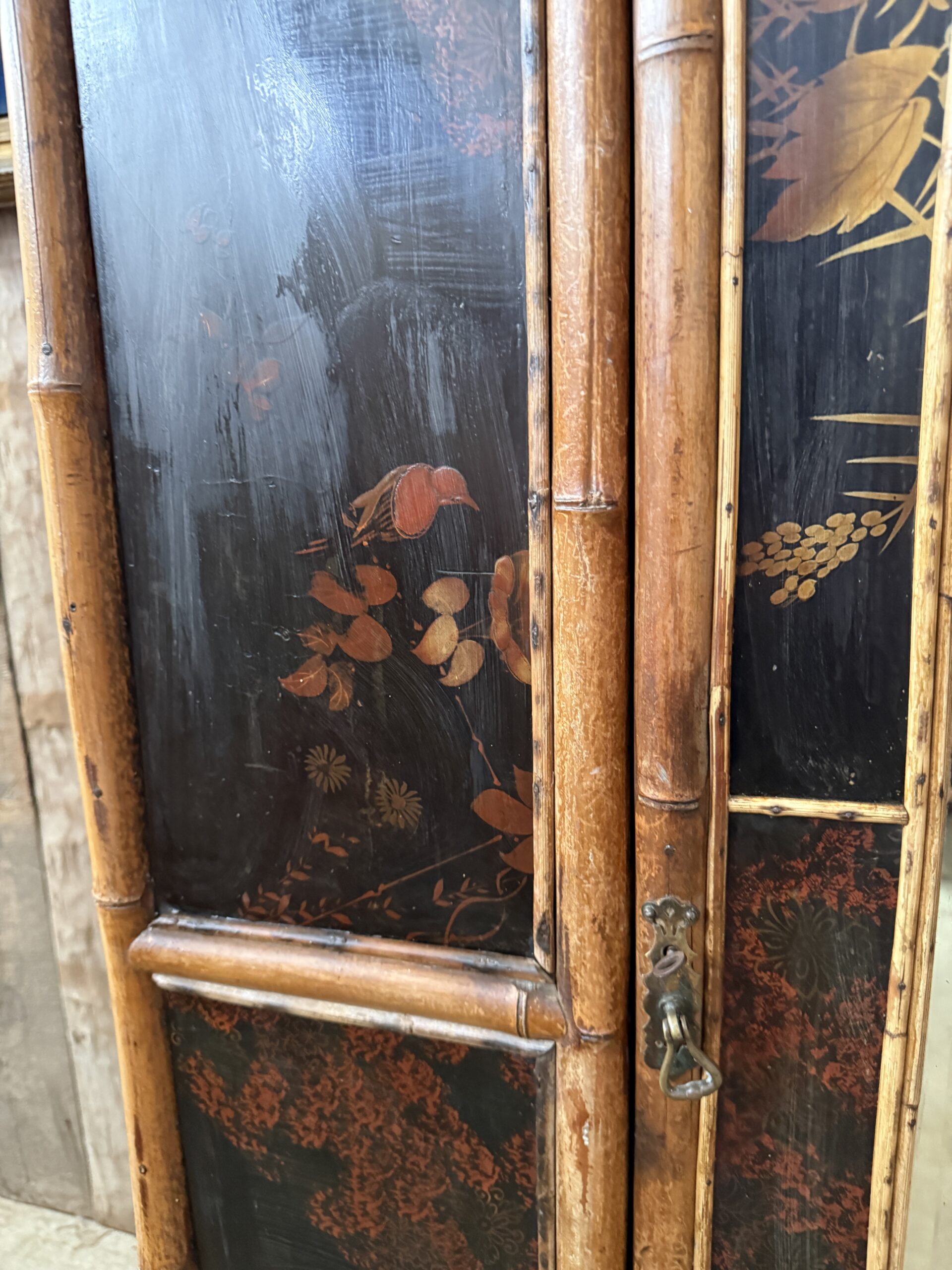
This is a particularly striking example of late 19th-century bamboo furniture. The architectural framework is formed from substantial lengths of natural bamboo, carefully selected and joined so that the characteristic nodes become part of the decorative composition. Within this warm honey-coloured framework are dramatic black lacquered panels decorated with stylised birds, flowers, foliage and trees in russet, ochre, gold and earthy red tones. The combination of black grounds, asymmetric naturalistic decoration and bamboo is immediately evocative of the Anglo-Japanese interiors fashionable in Britain during the final decades of the Victorian period.
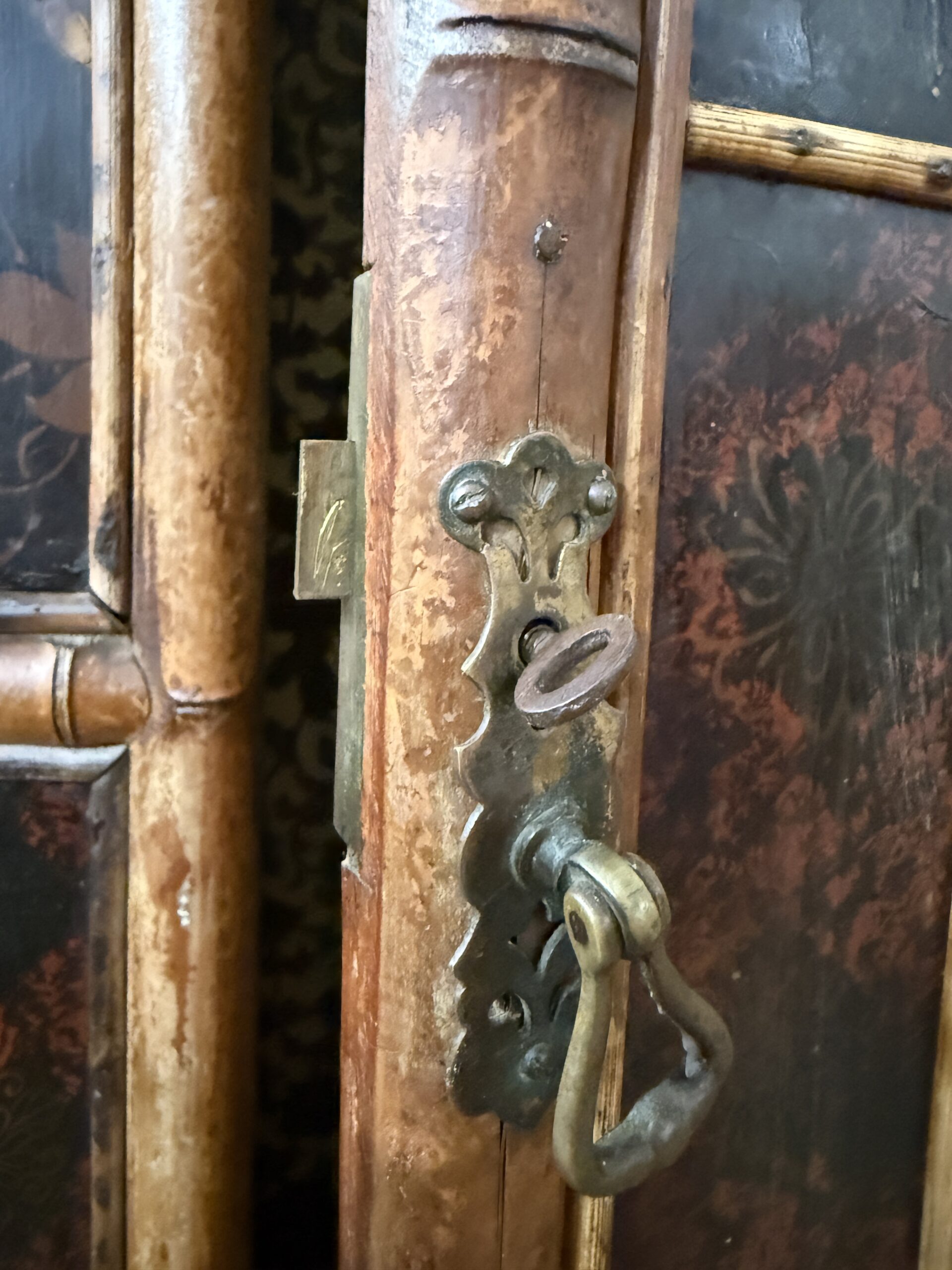
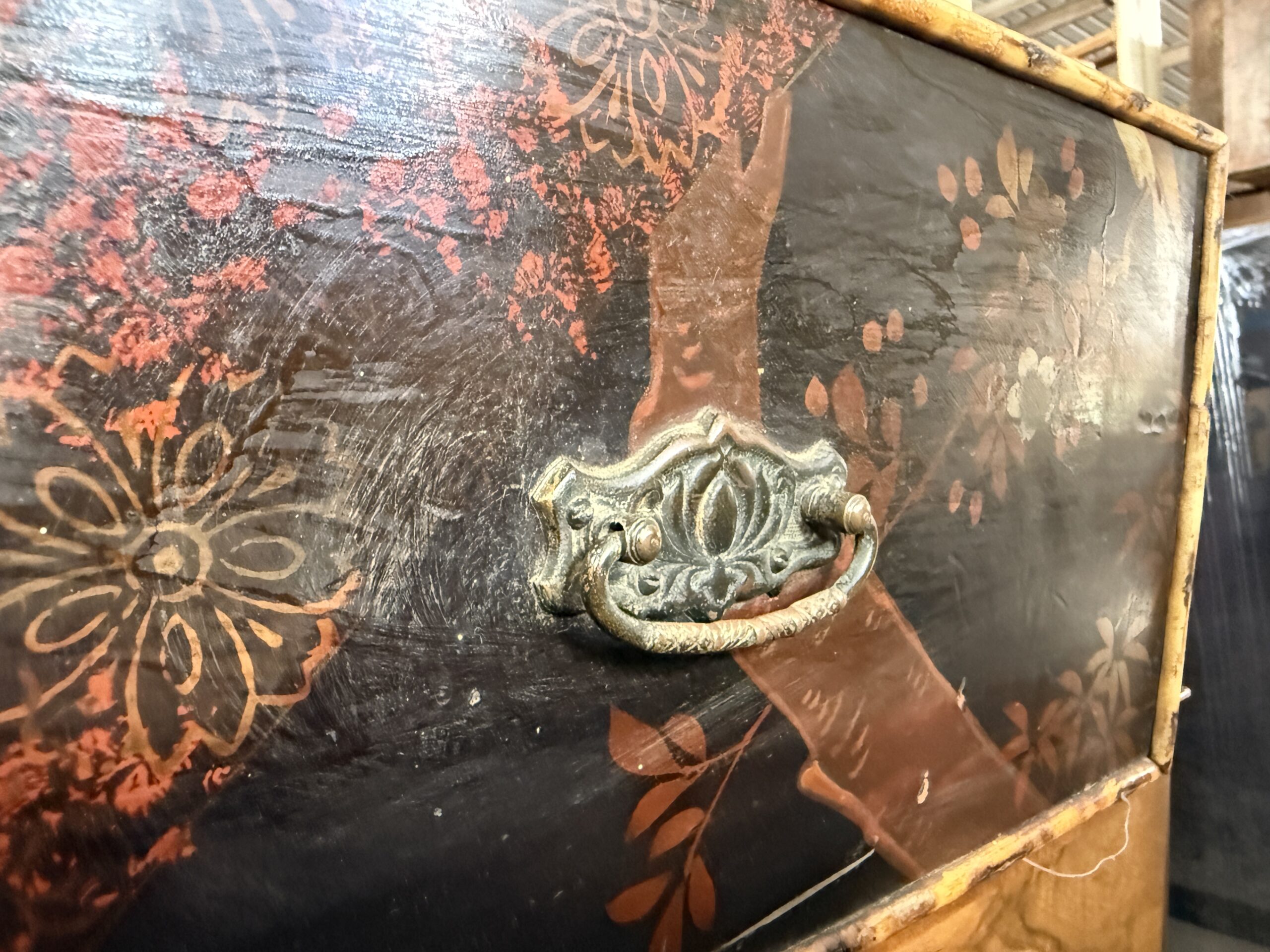
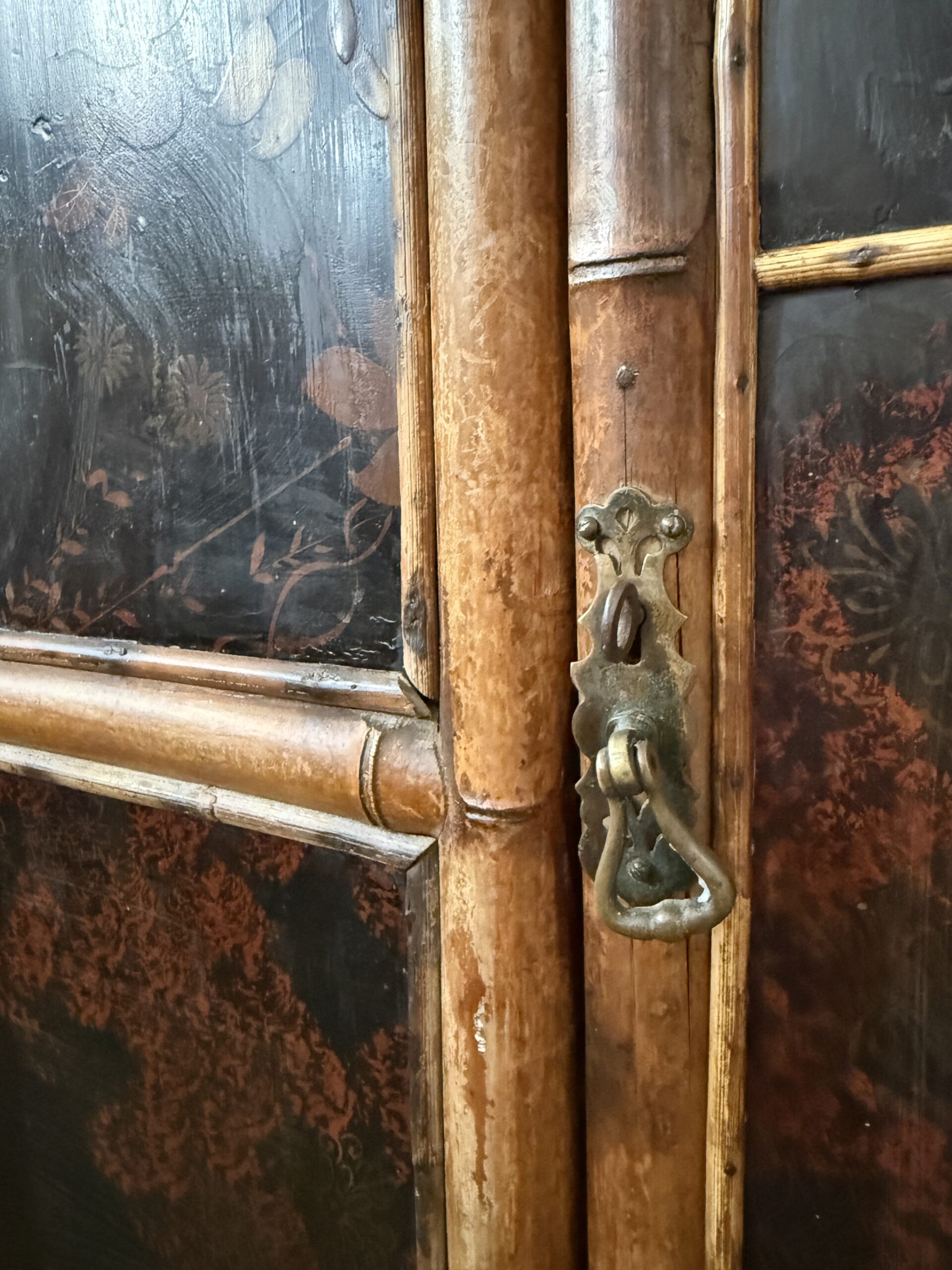
The central door is dominated by a tall rectangular bevelled mirror, itself surrounded by further decorated panels and multiple bamboo borders. To either side are tall decorative panels, creating an unusually rich and almost architectural façade. Below are two broad drawers, again decorated with birds and foliage and retaining decorative metal handles. The central door retains an attractive period-style brass escutcheon and drop handle.
More than simply a wardrobe, this is a wonderfully theatrical piece of Victorian Aesthetic Movement furniture and an excellent example of the late 19th-century enthusiasm for bringing exotic materials, Japanese-inspired imagery and handcrafted decoration into the fashionable British interior.
The Victorian Aesthetic Movement
The Aesthetic Movement emerged in Britain during the second half of the 19th century as a reaction against both industrial mass production and the heavy historical revivalism that had dominated much Victorian decoration.
Its central philosophy was famously associated with the idea of “art for art’s sake”: that beauty, craftsmanship, colour, pattern and visual harmony could be appreciated independently of moral or narrative purpose.
Artists, designers and tastemakers increasingly looked beyond traditional European historical styles for inspiration. Japanese art became particularly influential following the opening of Japan to international trade in the mid-19th century. Japanese prints, ceramics, lacquerware, textiles, fans and furniture entered European collections in increasing quantities, dramatically influencing Western ideas about composition and decoration.
Rather than the strict symmetry traditionally favoured in European decorative arts, Japanese design introduced Western audiences to asymmetrical compositions, birds, flowering branches, insects, grasses, water, landscape and other naturalistic motifs, often arranged against comparatively uncluttered backgrounds.
These influences became integral to what is now commonly described as the Anglo-Japanese style.
Designers including Christopher Dresser, E.W. Godwin and others associated with progressive Victorian design helped popularise an aesthetic in which Japanese principles could be adapted rather than simply copied.
The present hall robe fits beautifully within this decorative world.
Its black panels provide the dramatic ground associated with lacquered Japanese objects, while the scattered birds, foliage, flowers and trees have precisely the naturalistic, asymmetric character that appealed so strongly to late Victorian designers.
Bamboo Furniture & the Aesthetic Interior
Bamboo furniture occupies a fascinating position within the history of Victorian interiors.
Although bamboo had been used for centuries throughout Asia, its appearance within fashionable British and European homes became increasingly prominent during the later 19th century. Its naturally segmented stems provided something completely different from conventional mahogany, walnut and oak cabinet furniture.
To Victorian eyes, bamboo appeared exotic, informal and modern.
It became particularly associated with bedrooms, dressing rooms, conservatories and increasingly fashionable Aesthetic interiors. Chairs, occasional tables, cabinets, bookcases, overmantels, washstands, hall stands and wardrobes were produced using bamboo frameworks, frequently combined with lacquered, painted or Japanese-inspired decorative panels.
The material was particularly well suited to the Aesthetic Movement because the construction itself became decoration.
Rather than disguising joints and structural members beneath carving or veneer, bamboo furniture celebrated the rhythm of its uprights, horizontal rails and naturally occurring nodes. The result was furniture that could appear lighter and more architectural than conventional Victorian cabinetmaking.
This hall robe demonstrates that principle exceptionally well.
The bamboo is not simply applied decoration. Its repeated vertical and horizontal lines organise the entire façade, creating individual frames for the decorated panels and mirror. Smaller diameter bamboo is then used to create additional borders, producing a layered effect reminiscent of Japanese architectural screens.
The warm amber and honey colouring of the aged bamboo contrasts beautifully against the predominantly black decorative panels.
Chinoiserie, Japonisme & Anglo-Japanese Influence
Although pieces of this type are frequently described commercially as Chinoiserie bamboo furniture, the decoration also belongs firmly within the broader Victorian fascination with Japanese design generally described as Japonisme or Anglo-Japanese taste.
The distinction is worth making.
Chinoiserie had existed in European decorative arts since the 17th and 18th centuries and represented a Western interpretation of Chinese and East Asian imagery. By the late Victorian period, however, the enormous popularity of Japanese decorative arts introduced a distinctly different visual vocabulary.
This robe combines those traditions.
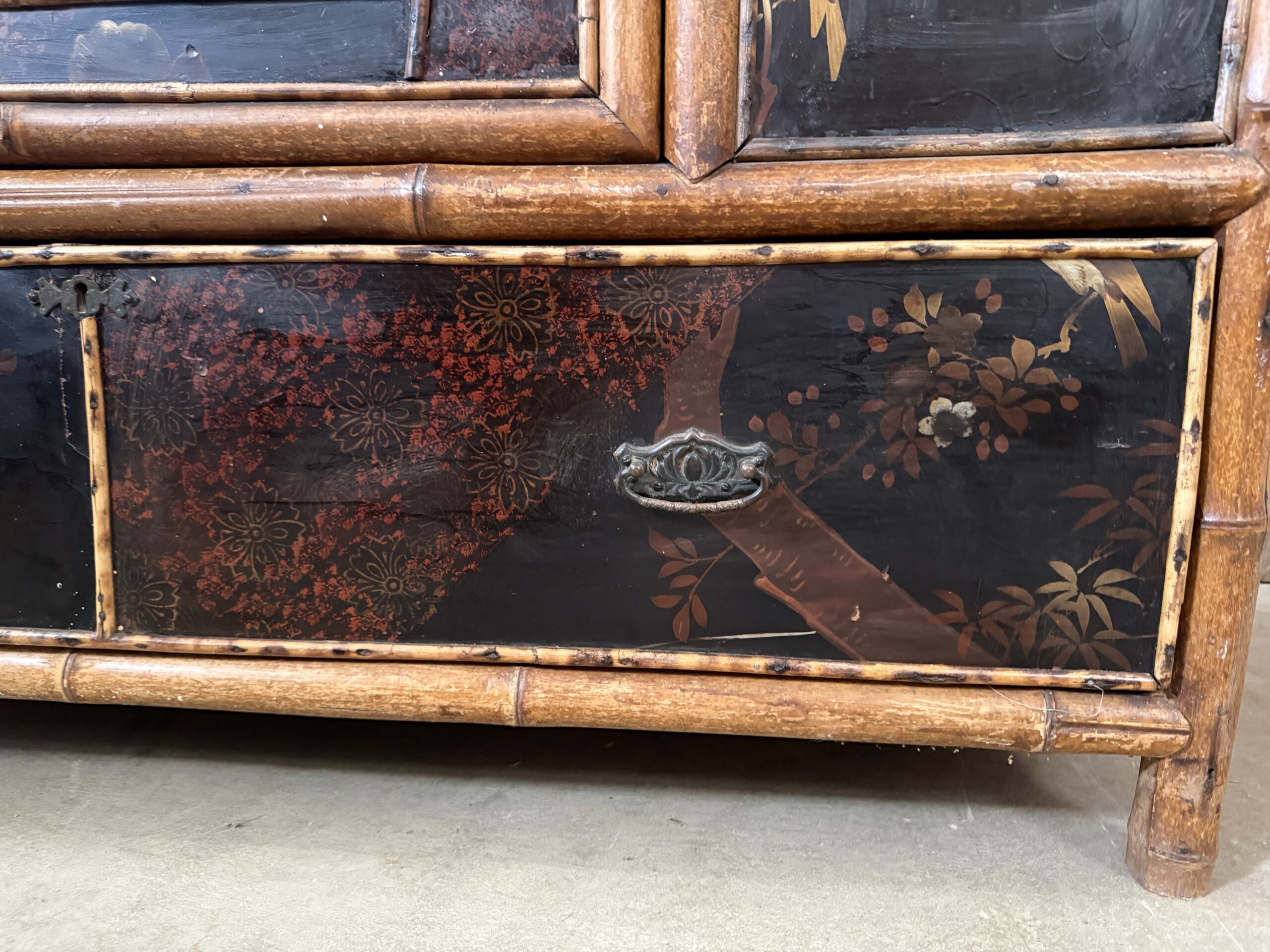
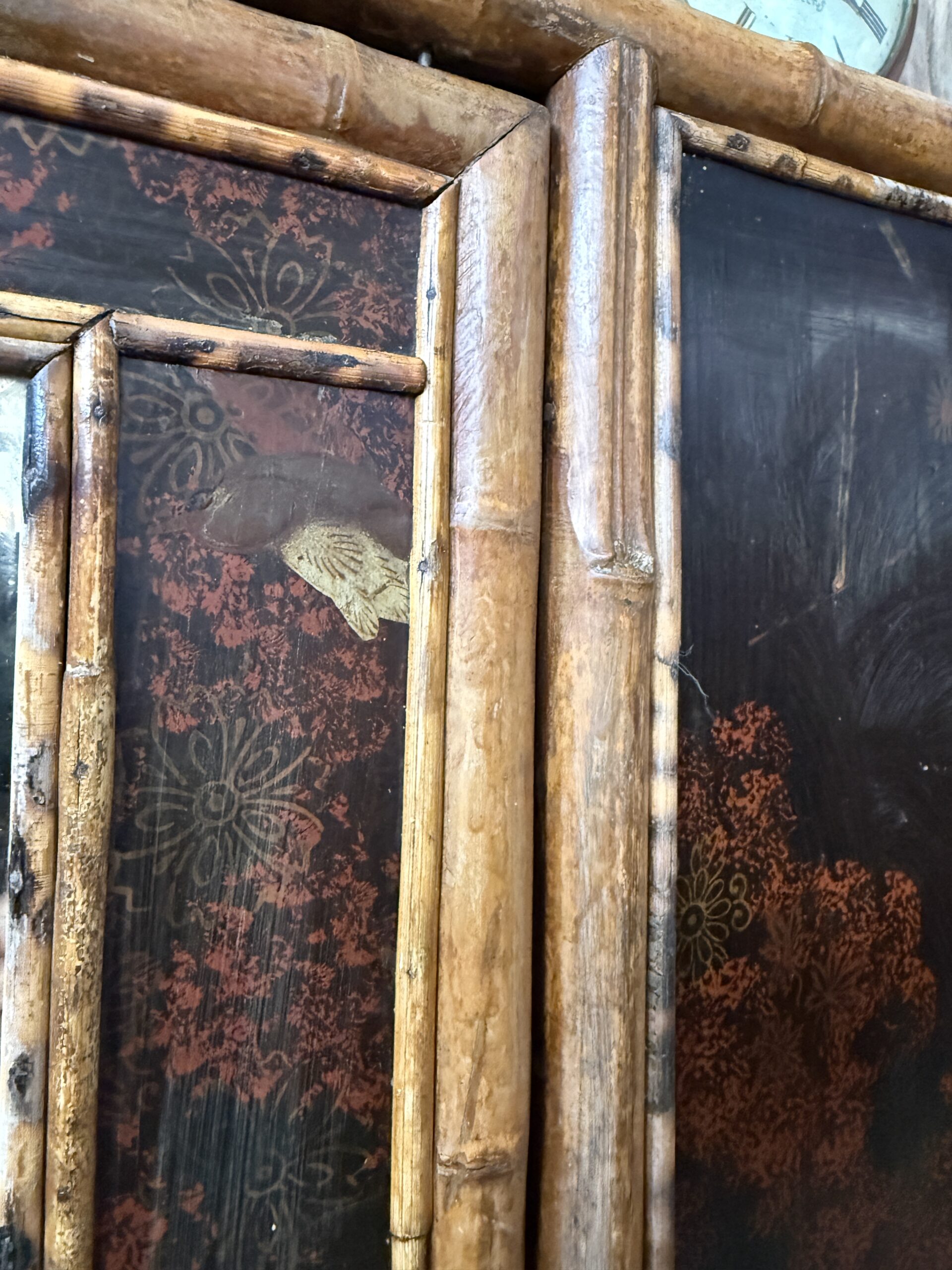
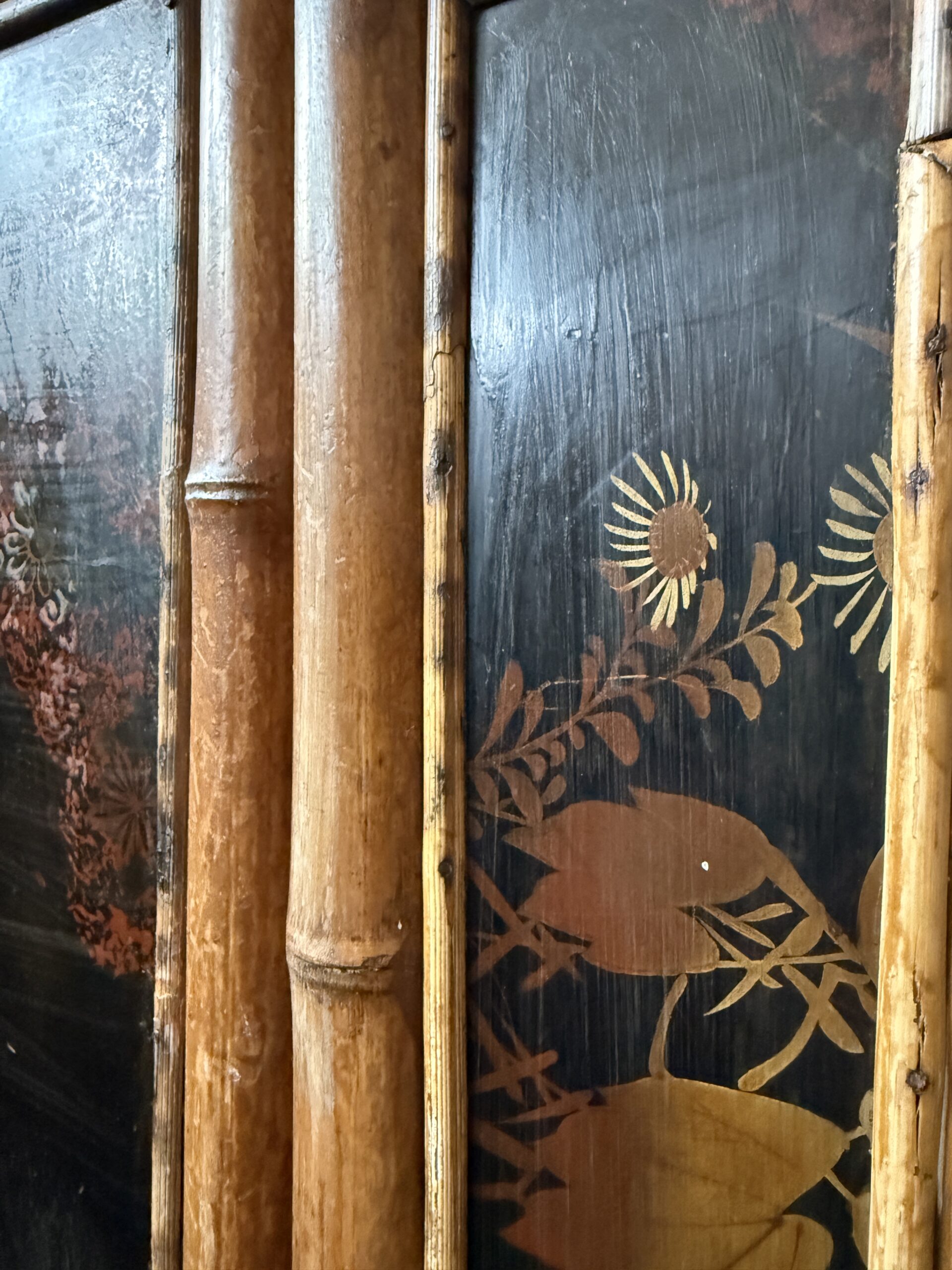
Across the black panels are delicate representations of birds, flowering plants, branches, leaves and stylised vegetation, arranged in loose compositions rather than rigid European symmetry. Gold, ochre, russet and red decoration emerges dramatically from the dark background.
Particularly charming are the individual birds appearing amongst the vegetation, including the prominent bird decorating the lower drawer front.
Rather than covering every surface with ornament, the decoration allows areas of black ground to remain visible. This balance between ornament and empty space is one of the characteristics that made Japanese decorative art so influential upon the Aesthetic Movement.
Design & Construction
The robe has a strong architectural presence despite its relatively manageable proportions.
A substantial bamboo outer framework rises upon four bamboo legs, while the front is divided vertically into three principal sections.
The central mirrored door projects visually forward from the flanking panels and is surrounded by several concentric bamboo borders. The bevelled mirror introduces another distinctly Victorian luxury and makes the robe particularly suitable for its intended use within a bedroom, dressing room or entrance hall.
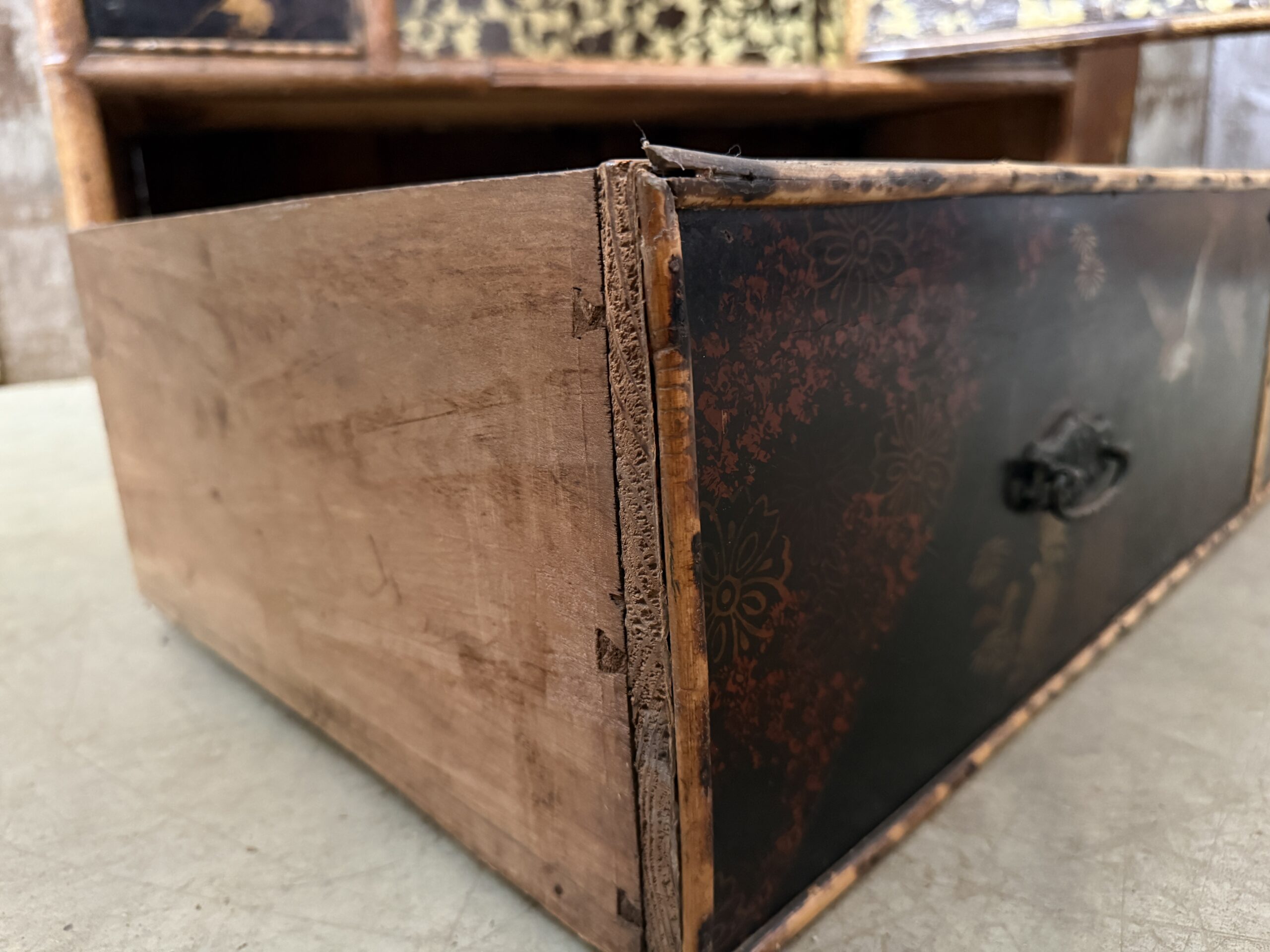
Below, the pair of drawers creates a strong horizontal base. Their black fronts continue the decorative scheme of the upper cabinet and are ornamented with birds, foliage and flowering vegetation.
The surviving metal drawer handles, door furniture and escutcheon provide another attractive layer of period detail.
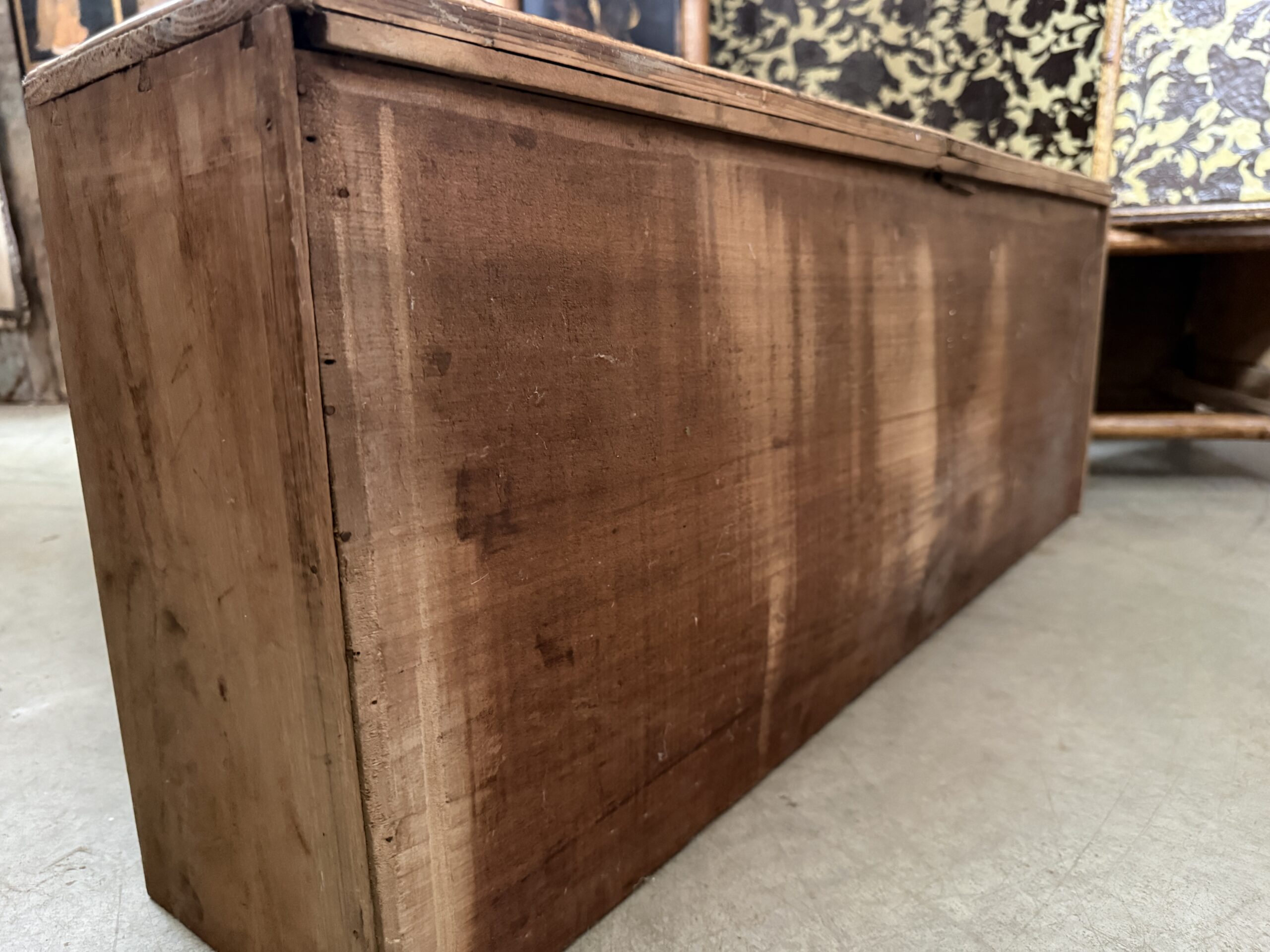
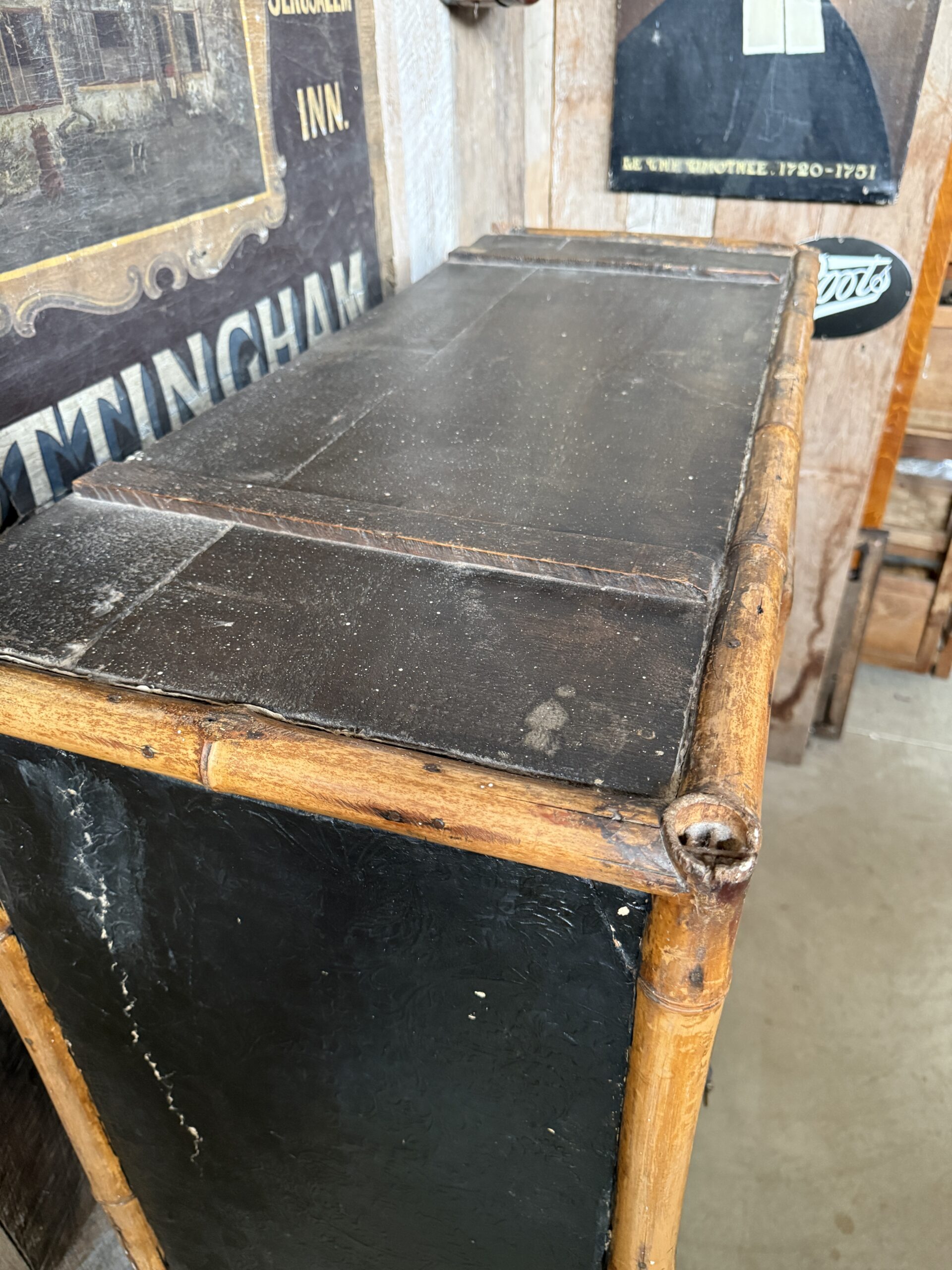
There is also considerable evidence of hand construction throughout. The bamboo varies naturally in diameter and colour, its nodes remain visible, and the joints possess the irregularity and individuality expected from furniture of this age.
Rather than detracting from the piece, these qualities are fundamental to its appeal.
Original Lincrusta Lining
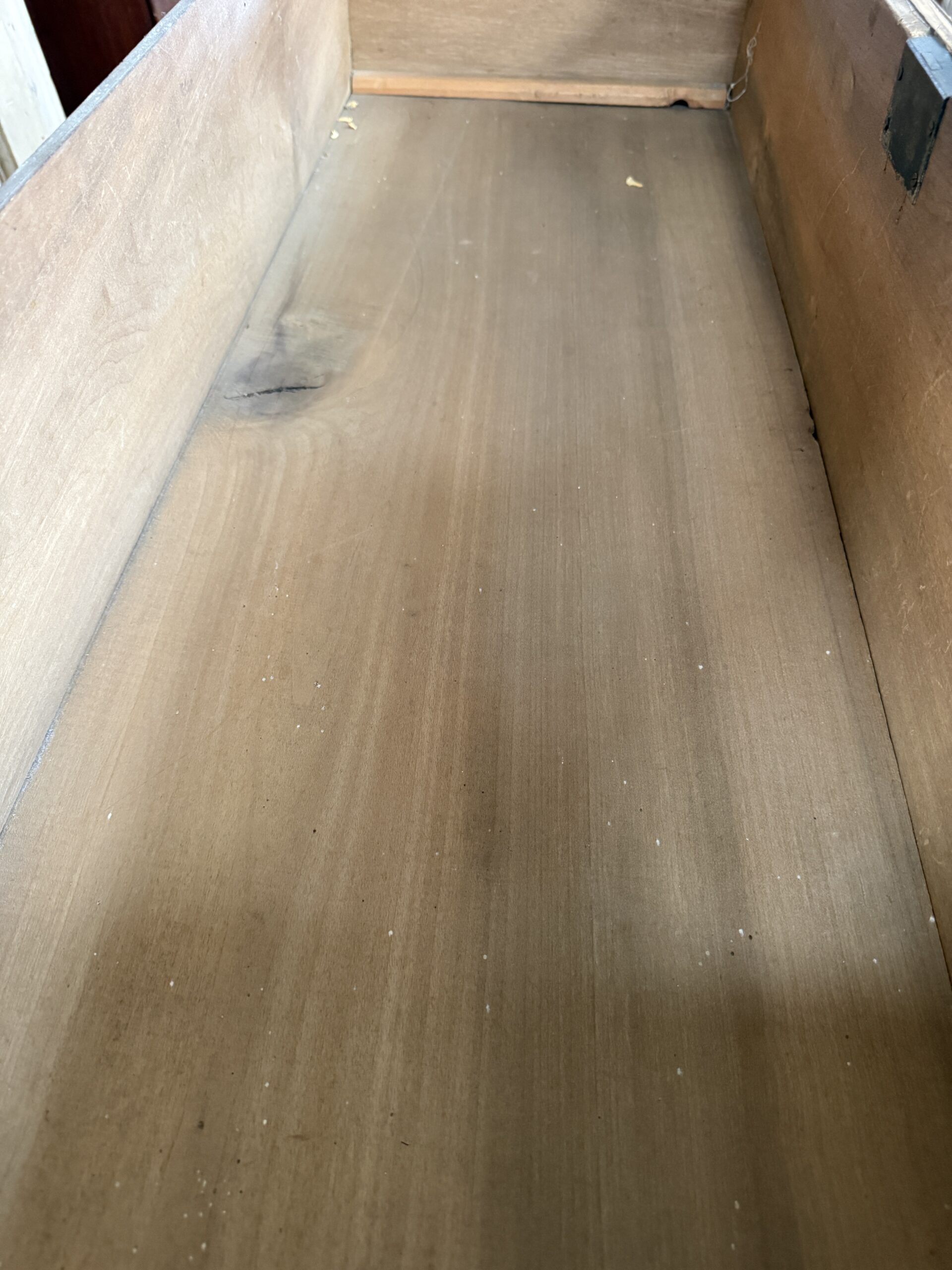
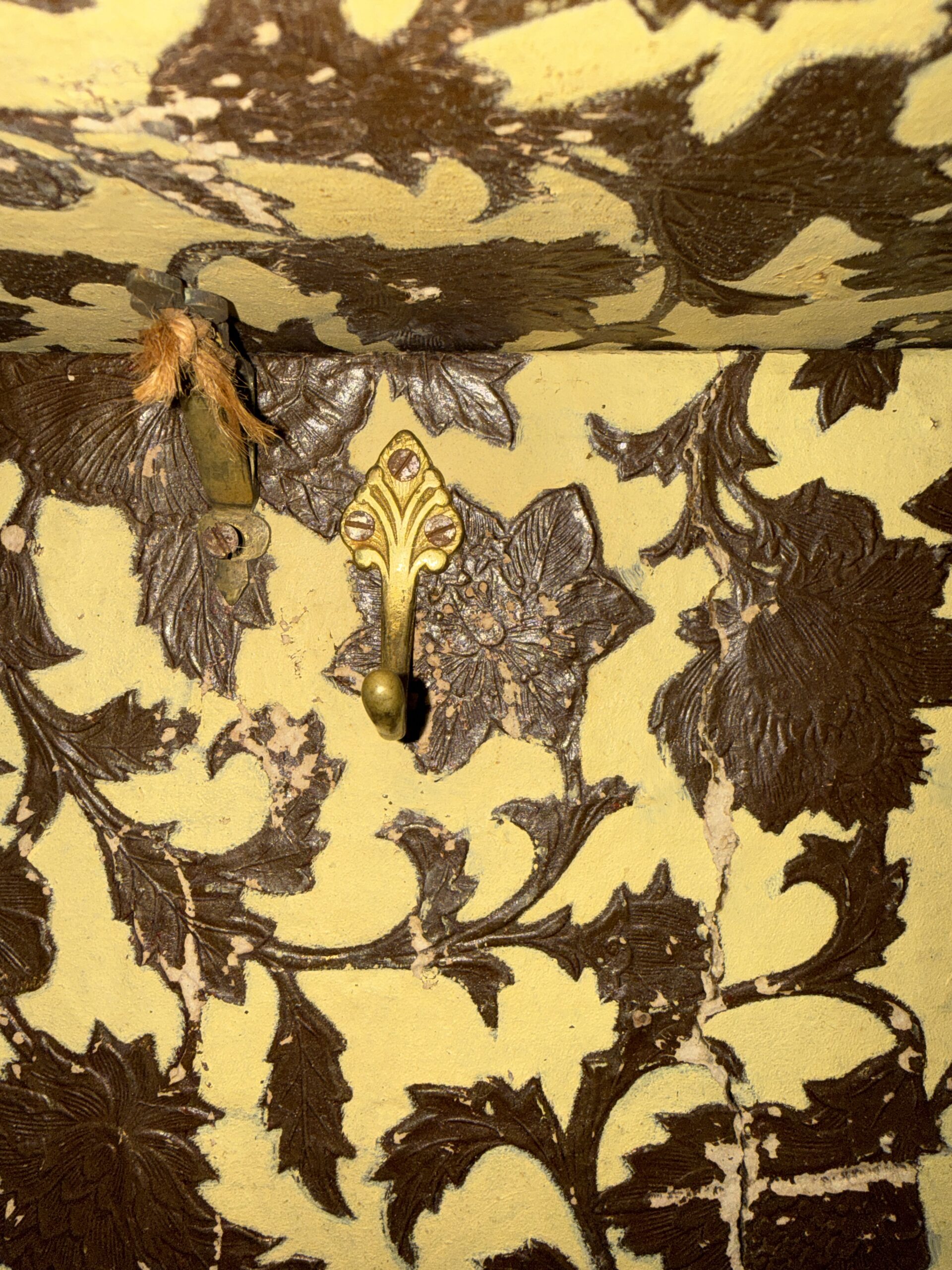
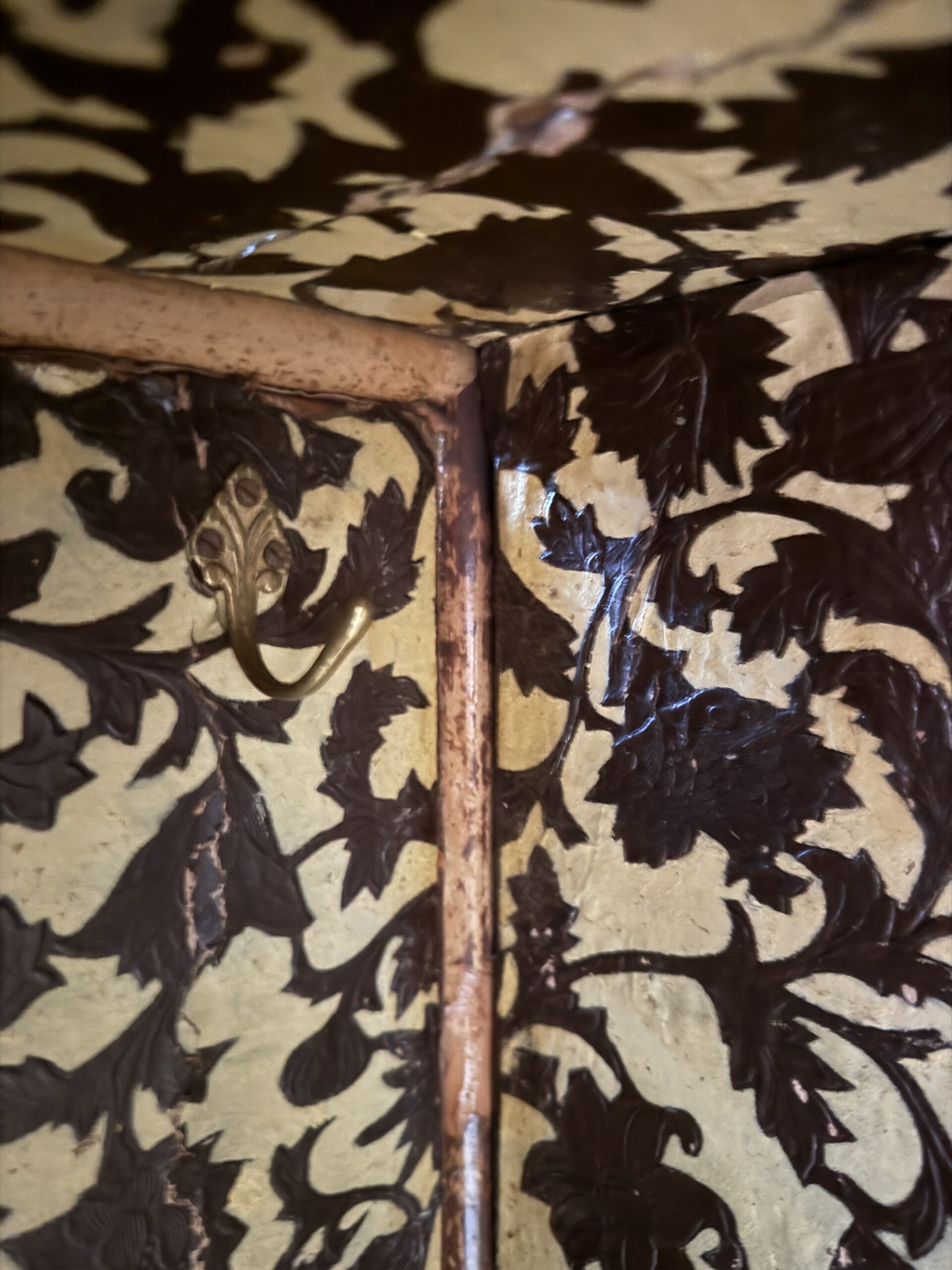
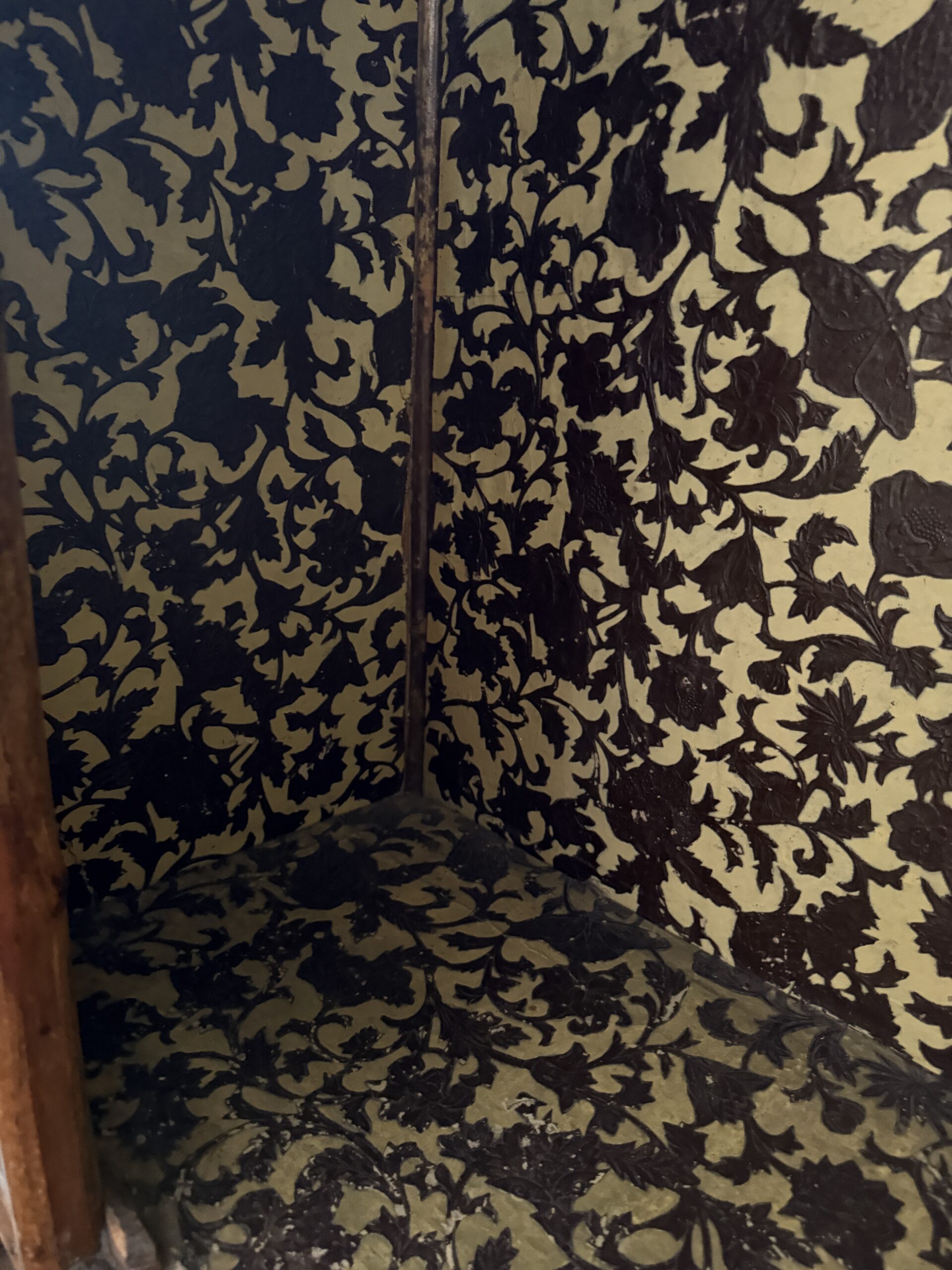
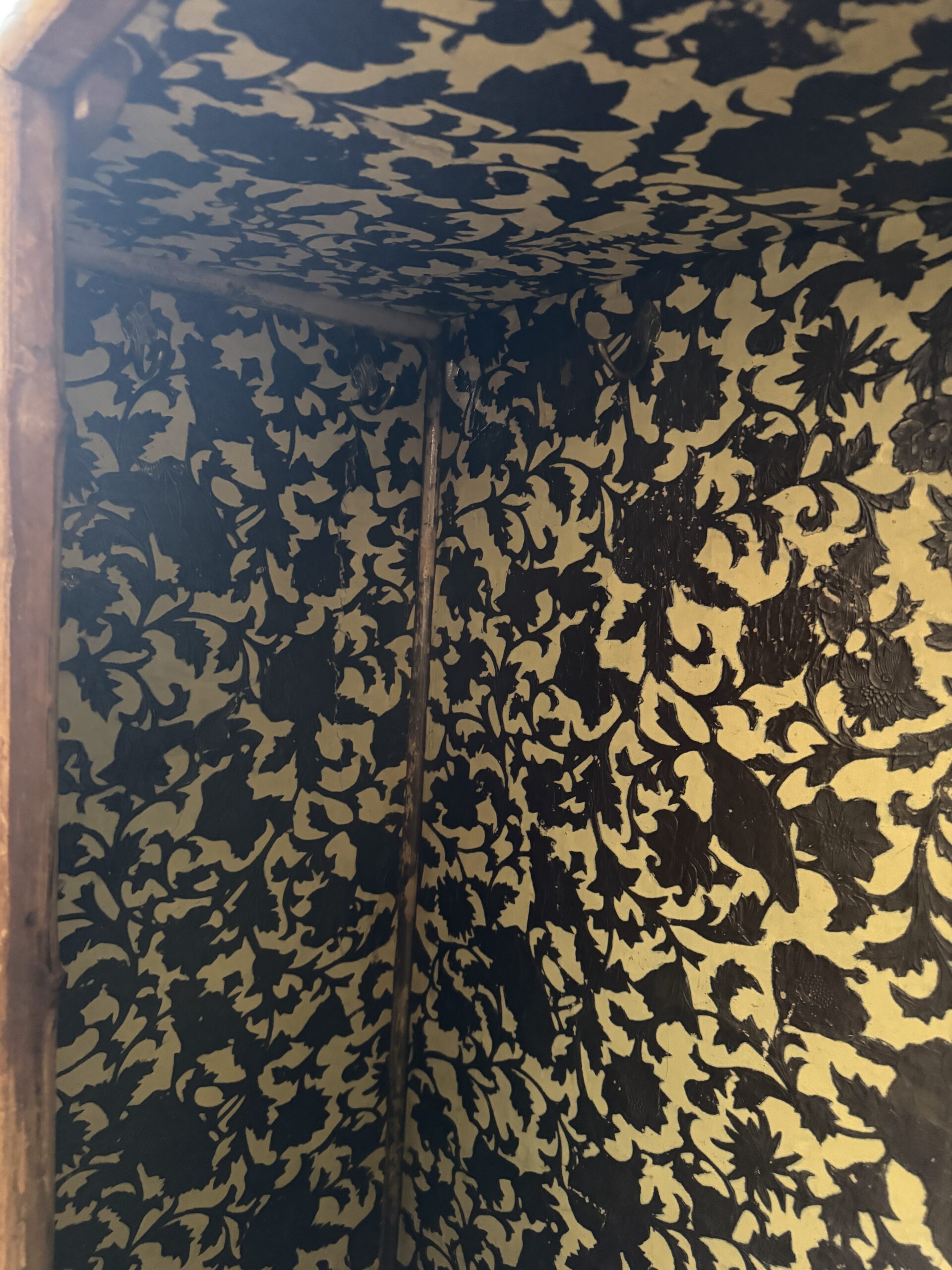
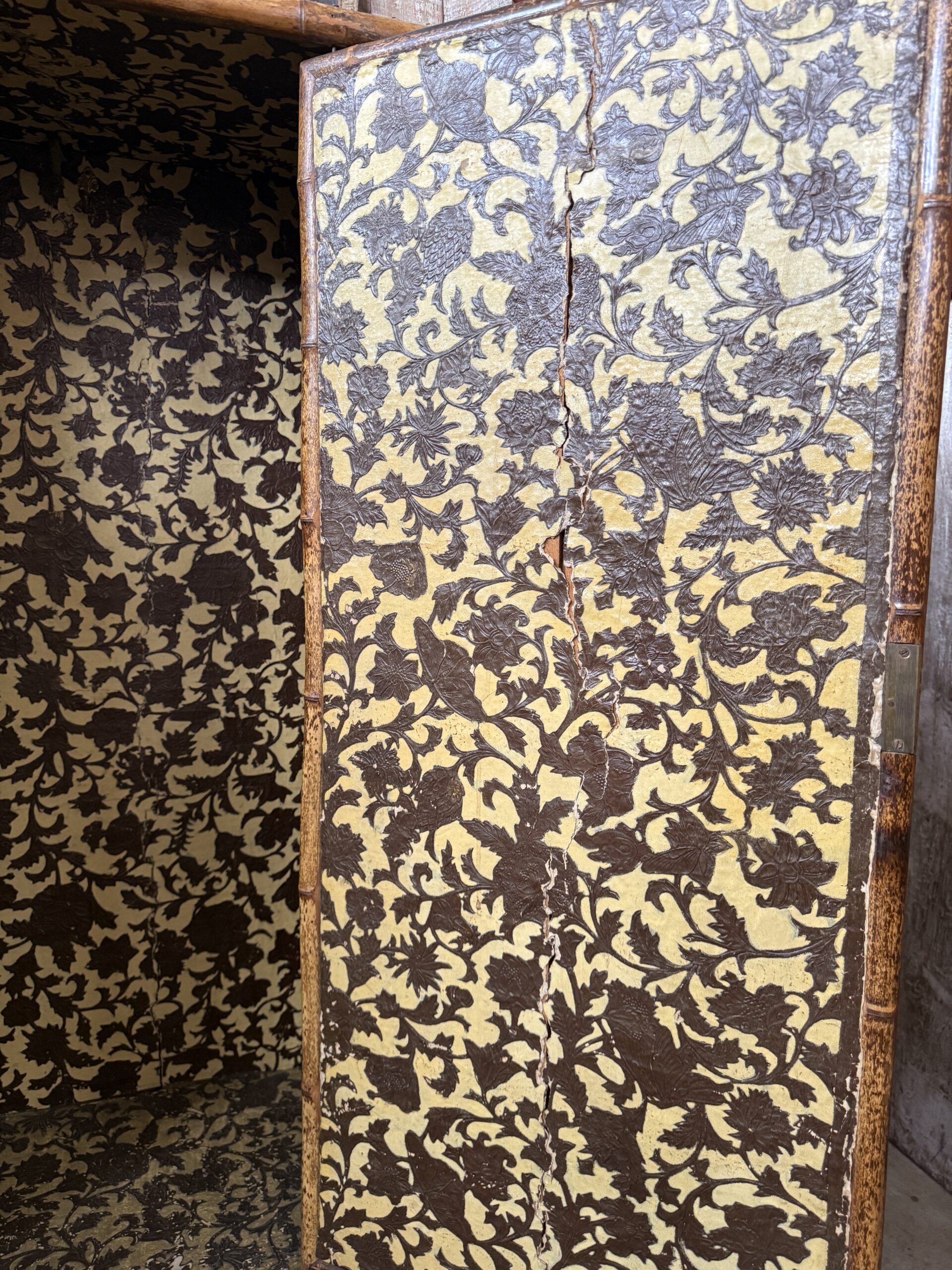
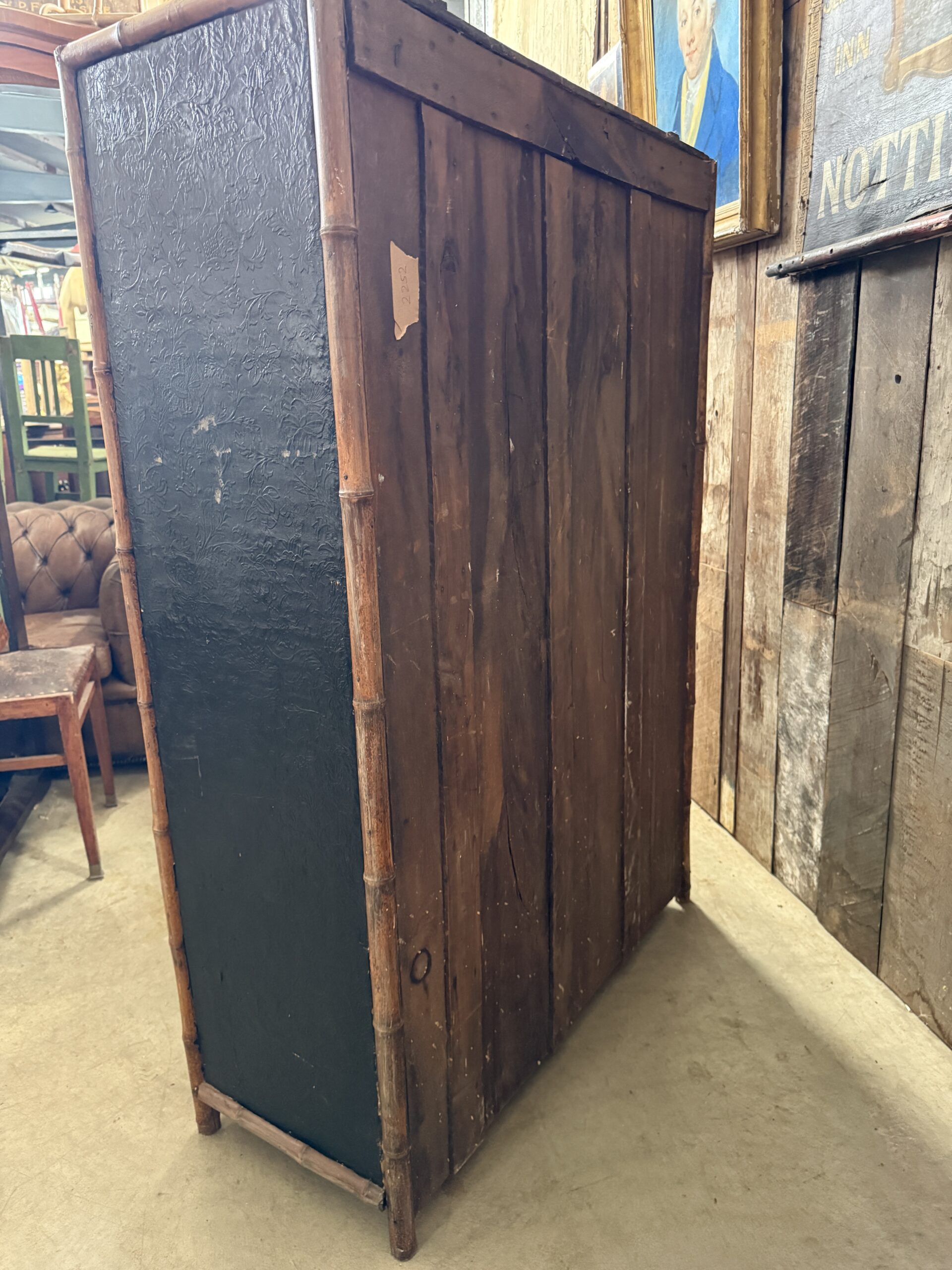
An especially interesting feature is the survival of the original embossed Lincrusta-lined paper.
Lincrusta was one of the great decorative innovations of the Victorian interior. Introduced during the 1870s, it provided a deeply embossed, durable wall covering capable of reproducing elaborate patterns and textures.
Its use here is entirely appropriate to the period.
The combination of bamboo, dark decorative panels, mirror glass and richly textured interior lining encapsulates the Victorian Aesthetic Movement’s love of contrasting materials and surfaces.
Where later furniture might favour a uniform finish, the Aesthetic interior actively celebrated variety: smooth lacquer against textured paper, dark decoration against pale bamboo and reflective glass against matt surfaces.
The retention of this historic lining therefore contributes considerably to the robe’s authenticity and interest.
Decorative Appeal Today
The extraordinary thing about late Victorian Aesthetic furniture is how comfortably it can sit within a contemporary interior.
This piece would naturally be spectacular within a Victorian townhouse, country house, dressing room or entrance hall, but its graphic black panels and sculptural bamboo framework would work equally well against a restrained contemporary wall.
It could form the focal point of a bedroom or dressing room, while the full-length mirror and internal storage retain the practicality for which the piece was originally intended.
For collectors of Aesthetic Movement, Anglo-Japanese and Chinoiserie furniture, it offers considerably more visual interest than the smaller bamboo tables and occasional pieces more frequently encountered.
It is ultimately a piece of furniture that embodies a particular moment in British design history: when the Victorian interior began looking beyond Europe and discovered an entirely new language of pattern, asymmetry, nature and exotic materials.
Dimensions
Height: 1520 mm / 152 cm / 59.8 in
Width: 1051 mm / 105.1 cm / 41.4 in
Depth: 420 mm / 42 cm / 16.5 in
£1,650.00
1 in stock
UK Delivery
3-5 working days Mainland UK
Click & Collect: FREE
International Delivery
We ship Worldwide, you will receive a quote within 3 working days of your order (or contact us in advance)
Returns
Hassle-free, no quibble returns – just let us know within 24 hours of receiving delivery
Please note: we do not refund delivery charges and you will be responsible for the cost of returning the goods to us (equivalent to the original delivery charge)
Collect easily and conveniently from our warehouse;
Longhedge Road, Sibthorpe NG23 5PN
There is a large loading bay immediately outside the front of the shop, our staff will carry items to your vehicle.
Call our team on 07732 957 234 or email hello@belvoir.co with your query or video request.
19th century bamboo furniture, Aesthetic Movement wardrobe, aesthetic period furniture, Anglo Japanese bamboo furniture, Anglo Japanese furniture, Anglo Japanese wardrobe, antique Aesthetic Movement furniture, antique bamboo armoire, antique bamboo bedroom furniture, antique bamboo cabinet, antique bamboo hall robe, antique bamboo wardrobe, antique Chinoiserie furniture, antique dressing room wardrobe, antique embossed wallpaper furniture, antique hall furniture, antique lacquered bamboo furniture, antique mirrored cabinet, antique mirrored hall robe, antique Oriental furniture, bamboo armoire, bamboo bedroom furniture, bamboo mirrored wardrobe, bevelled mirror wardrobe, black lacquer bamboo cabinet, c1890 bamboo furniture, Chinoiserie bamboo wardrobe, country house bamboo furniture, decorative Victorian furniture, English Aesthetic Movement furniture, Japanese decorated wardrobe, Japanese inspired Victorian furniture, Japonisme furniture, late Victorian wardrobe, Lincrusta lined wardrobe, original Lincrusta furniture, rare Victorian bamboo furniture, Victorian Aesthetic Movement Bamboo Chinoiserie Mirrored Hall Robe, Victorian aesthetic movement furniture, Victorian bamboo cabinet, Victorian bamboo hall robe, Victorian bamboo wardrobe, Victorian bevelled mirror, Victorian bird decorated furniture, Victorian Chinoiserie furniture, Victorian dressing room furniture, Victorian exotic furniture, Victorian hall furniture, Victorian Japonisme, Victorian Lincrusta interior, Victorian mirrored wardrobe
Browse more Antiques, Cabinetry, Armoires / Wardrobes, Hanging Cupboards, Housekeeper’s Cupboards
-
Antique English Oak Lowboy Hall Table Desk, c 1760
£750.00 -

Antique Oak & Leather Barristers Arts & Crafts Desk, c 1890
£1,500.00 -
Antique French Chestnut Refectory Bakers Farmhouse Table, circa 1810
£2,700.00 -

Antique Queen Anne Period Walnut Lowboy, c 1710
£950.00 -

Vintage Swedish Design Teak Coffee Table, by Albert Larson
£550.00